James Madison University recently announced plans to construct an 8,500-seat arena to house the campus’s men’s and women’s basketball teams. The arena, set to cost $88 million, also will host public speakers, serve as the university’s convocation and graduation center, and provide space for high school graduation ceremonies, concerts, conventions, trade shows, and family-style entertainment.
Slated to feature premium seating areas, the new arena will include a club level, private suites and hospitality spaces, and pre-event spaces for students. But its central purpose will be to serve as the locus for the university’s basketball programs. It will house high-quality offices, locker rooms, training spaces, meeting rooms, and a full-court practice facility with six shooting stations.
“These days, college basketball revolves around recruiting,” observed Eric Willin, COO of EZFacility, a sports center management software developer in Woodbury, New York. “James Madison University’s new facility certainly will give the campus an edge in attracting the best student-athletes and developing their skills.”
The university has not yet announced a date for construction to begin. A fundraising goal of $12 has been set, but university officials stated that all support must be secured before construction on the project can begin. While no formal timeline has been delineated, the university is actively fundraising.
Author: ezfacility
$1 Million-Dollar Gift To Enhance University’s Athletic Training Facility
Florida Gulf Coast University (FGCU) received a $1 million gift for the expansion of the strength and conditioning facility at its on-campus arena. The new facility will be added to the existing arena, and will exclusively serve the university’s 250 student-athletes. Currently, the student-athletes share a weight room with the general student population.
Donors Jim and Donna Sublett wanted to increase opportunities for athletes to train intensely. In a press release, Jim Sublett said, “Many FGCU student-athletes will continue to bring honor and recognition to the university, partially because of the excellent new facility to fine-tune their bodies, skills, and talents.”
Eric Willin, COO of EZFacility, a sports facility management software developer in Woodbury, New York, remarked on the benefits of focused training for athletes. “Having access to a facility designed exclusively for athletic training will allow FGCU’s student-athletes to practice more intensely, develop a greater sense of what their bodies can do, and challenge themselves in a more community-centered atmosphere. The new strength and conditioning facility is great news for the university’s sports teams.” The Subletts’ donation represents part of a $12 million capital campaign FGCU’s athletic department is running. Approximately $7 million of that amount will allow for planned updates to the arena, including the new strength and conditioning facility, and $5 million will go toward scholarships, recruiting budgets, and additional facility enhancements.
Enabling Accessibility
At the climbing gym I frequent, there’s a man whose left arm ends in a stump. He’s a veteran who lost his hand in Iraq. I know how hard it is scaling those thirty-foot walls with all my limbs intact; watching this guy, I can’t help but feel humbled and awed. He does it with no special accommodations. He just figures out what will work for him, and up he goes.
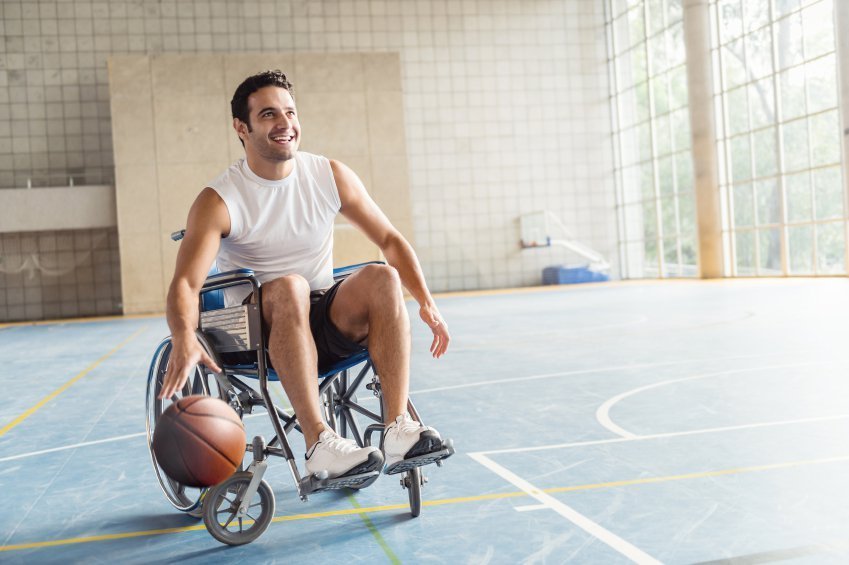
Indoor climbing is especially flexible in this way — the whole point is to do what you have to do to get to the top, no matter what particular challenges you might be facing. But, what about other, less universally approachable sports or exercises? What about just watching sports? How can we make participating in sports, working out, and being a fan in the stands more accessible for anyone who wants to take part?
There are a few things to consider as you gauge your facility’s accessibility and think about what changes, if any, to make. First, there’s the ADA, or Americans with Disabilities Act. Enacted in 1990, this law requires public places and commercial facilities to comply with guidelines that allow for wheelchair accessibility and other disability considerations. Facilities constructed before 1990 are not required to meet the specific stipulations of the ADA — such as that wheelchair spaces be at least 36 inches wide, with equal, adjacent space for a companion — but such facilities are under obligation to remove existing barriers. And any facility refurbishing its space must bring it into ADA-compliance.
So, for example, when Hampton-Dumont High School in Hampton, Iowa, decided to replace its fifty-five-year-old wooden bleachers recently, it had to create a new deck with room for six wheelchairs, plus companion seats, and a ramp. The project’s total cost was about $20,000 — but the alternative, building an entirely new stadium, would have cost the school at least a quarter of a million dollars. The lesson here is that changes you make to bring your facility into ADA-compliance, whether you run a gym, niche fitness center, or sports venue, need not cost a fortune. The money you spend will pay off. In Hampton-Dumont’s case, the school forged a better relationship with the community after the reconstruction because now no one was shut out. In the end, more tickets were sold at events.
If you’re not ready to refurbish, there are other steps you can take to make your facility more welcoming of people with special considerations. If you’re a gym with regular exercises classes, consider the possibility of designing a wheelchair class. You’d need to hire an experienced instructor and make sure the room where the class will be held is completely accessible. Also consider hosting workshops about exercising with a disability, and see whether you can create areas in your free-weight, cardio, and machine spaces solely for wheelchair users or others who need particular physical accommodations.
In addition, think about how you can make your commitment to inclusivity known. No matter what kind of facility you run, the more you spread the word about your accessibility, and the more you make it known that you welcome all kinds of members, the greater your standing in the community will be, and the more chances you’ll have of attracting an untapped segment of your local population.
Overall, you want to think in terms of being an ally to folks who are differently abled. As an organization dedicated in some form or other to physical activity, you bear a particular onus: how to enable physical activity for everyone. When it comes to issues of accessibility, gyms and sports facilities have a chance to shine.
Helping Your Members Find Their Own Way
I have a confession to make: Exercise bores me. Don’t get me wrong — I love staying fit, and I love the way I feel after a great workout, but no matter what exercise routine I try, after a while I get bored and want something new. For a while I was into spin classes. Then it was Zumba. Then aquatic aerobics, HIIT-style repetitions, and just plain jogging. Now I’m all about indoor climbing. I was starting to think there’s something wrong with me, but then I stumbled across a post on the “Be Active Your Way” blog, a publication of the Department of Health and Human Services. Written by Alexandra Black, a dietician and IHRSA’s Health Promotion Manager, the article is not about keeping exercise interesting — but it nevertheless put my mind at ease and inspired me to continue trying new routines.
What the article is about is this: using trial and error to determine the best workouts for individuals. “Each person,” Black writes, “has a unique genetic makeup, different life experiences, and varied medical histories that make it nearly impossible to prescribe one great diet or one great fitness plan for all.” Because of this, she says, the best way for individuals to figure out what works for them is through trial and error. The health and medical industries are beginning to recognize this, and the result of moving away from a one-size-fits-all mindset is better care and better long-term health for people. Black puts it this way: “As the trend towards individualized healthcare continues, we’re recognizing that every person is different, and that treating them as such — both in healthcare and in wellness — is often where the real magic happens.”
Which brings me back to my boredom issue. Reading Black’s thoughts on trial and error made me realize that the only way for me to find a routine that doesn’t eventually bore me is to keep trying new ones — and that it’s okay to do so. Maybe I just haven’t found the right one yet, and I need to keep searching until I do. Or maybe it’s the case that my genetic makeup, life experiences, and medical history make me a person who needs constant changes in her workout routine in order to most benefit from working out. Whatever the case, thinking about fitness as something that requires an individualized approach completely changes the way I think about working out. It gives me a feeling that I have permission to keep trying whatever I want to try.
Why am I sharing all this? Because chances are that an individualized fitness approach is something that would appeal to your members too. Of course, if you have personal trainers or some kind of personalized workout program, you already promote individualized fitness — but doing so explicitly could put your members at ease (enough so that they renew their memberships and talk your facility up to all their friends and social network connections). Defining individualized fitness and explaining its benefits — through posters, emails, social media, and one-on-one sales and promotion pitches — can help your members feel freer to engage in their own trial and error, giving new workouts and exercises a try, experimenting until they know what works best for them. And helping them in that way greatly increases the chances that they’re going to keep coming back to you.
Atlanta Braves Propose New Training Facility in St. Petersburg
The Atlanta Braves are proposing moving their spring training facility from the Orlando area to St. Petersburg, Florida. In a formal proposal submitted to officials of Pinellas County, where St. Petersburg is located, Braves president John Schuerholz noted that he hopes to reach an agreement to relocate by the end of the year. Construction of a new training facility would begin by next year, with completion scheduled for 2018.
Eric Willin, COO of EZFacility, a sports facility management software developer, said that the construction of a new facility would be a boon to the baseball team, which would spend less time traveling to practice space and more time on the field. “Also,” he noted, “the proposed facility includes a 10,000-seat stadium with berm seating for an additional 1,000 fans. Along with additional athletic fields and an on-site hotel, that would make the new facility a clear destination for amateur and professional sports alike.”
The Braves have trained at Disney’s Wide World of Sports in Lake Buena Vista, Florida, since 1998, but the team’s lease there expires in 2017. The St. Petersburg location is not the only one under consideration for the new facility, but Braves president John Scheurholz implied in a letter submitted to county officials that it is the most desirable one.
Most likely, any move the Braves make will include public financing. The Astros and the Nationals recently launched new training sites of their own, leaving the same Disney location that the Braves are leaving, and each team received a $108 million pledge in public funds from Palm Beach County, with the state pledging another $50 million toward costs of building and financing the planned facilities.
How Do You Green the Green?
I’ve written in this space before about greening sports — using sustainable energy sources, choosing healthier and more efficient building materials, recycling, avoiding cleaners with harmful chemicals. But if you run an athletic center with fields, how do you green those fields? It’s ironic, of course — nothing should be greener. However, in order to stay in perfect shape for game day, natural turf fields require a regimen of chemical applications, mowing, and irrigation that consumes valuable resources, creates waste, and potentially damages the environment.
The good news is, there are a few steps you can take to reduce harmful practices. Consider the following:
1) Choose chemicals that are more environmentally friendly. In an ideal world, we’d eliminate the use of pesticides and fertilizers altogether. Unfortunately, the world isn’t ideal. To maintain budgets and properly oversee highly-trafficked fields, facilities have few alternatives but to treat fields heavily. And, while Environmental Protection Agency regulations have banned most hazardous chemicals from products used for field maintenance, there is still a wide range of products available, some of which are more harmful than others. Whenever possible, choose organic materials for fertilizing and pesticide treatment, not synthetic ones. Coffee grounds, chicken manure, and turkey manure are good alternatives.
2) Reduce water consumption. You need water to keep those fields bright and healthy, but keep in mind that water is a precious commodity: The State of California recently announced it is suffering its worst drought in 1,000 years. How do you use less water and make the most of the water there is? Install systems for reclaiming stormwater and runoff. And then make sure you manage irrigation properly. If it rains one day and there’s plenty of moisture in the soil the next, don’t keep the irrigation system running. Also, consider irrigating only when wind is low, in order to keep evaporation rates down.
3) Re-evaluate your machinery. If you’re using straight-up fuel to power your mowers, look into the possibility of obtaining equipment that runs on biofuels or other clean alternatives. If that equipment does not fit in your budget, cut back on mowing frequency.
4) Think long-term. Whatever you’re doing with your fields today, ask how those practices will affect the immediate and larger environment in the future. If you renovate your fields, can you pulverize material and stockpile it for use elsewhere — on a golf course, for example? Can you create a pond or holding tank to capture water when you irrigate, and then find ways to re-use that water? Can you use material from old fields to fertilize new ones?
5) Ask the experts. Entire university departments exist to research sports turf maintenance. If you want to take a stab at greenifying your fields, reach out to people in the know. They’ll be able to tell you the best type of grass for your locale and particular uses, how often different grass varieties need mowing, what kinds of computerized weather and irrigation systems you might consider installing, and a host of other details that will get on the road to ever greater sustainability.
PAC Report
I was surfing around on the Internet the other day when a jarring Club Industry headline caught my attention: “American Physical Inactivity Reaches Six-Year High, Club Memberships Increase.” It doesn’t seem to make any sense, but according to a recent report from the Physical Activity Council (PAC), a group made up of IHRSA and five other sports and manufacturer associations, it is the case that 82.7 million Americans (28.3 percent) were physically inactive in 2014, an increase of 0.7 percent from 2013. It is also the case that health club memberships have grown by 18.6 percent since 2008, with the total number of health club visits in 2014 surpassing five billion for the second year in a row. Health club members checked in an average of 103 times in 2014, an all-time high.
What does it all mean? The data, based on nearly 11,000 online interviews carried out with a nationwide sample of individuals and households, suggest that the country’s fitness-related crises — obesity, diabetes, heart disease, and the like — are here to stay, and perhaps only getting worse. But at the same time, more and more people are joining health clubs and they’re visiting their clubs more often.
It can be hard, with statistics, to make meaningful interpretations and arrive at some kind of truth. But it seems safe to say, at the very least, that the news from the Physical Activity Council is both good and bad. As Tom Cove, PAC chairman and president and CEO of the Sports and Fitness Industry Association put it, “While we can look at [the physical inactivity] number in a negative light, I would like to use it as a wakeup call to not only our industry but the rest of society. It’s time we put our time and resources into industry initiatives and national campaigns to increase physical activity.”
In other words, the number may be alarming, but we can use it to start instigating change. And there’s no group better positioned to do so than the fitness industry — especially given that other statistic, the steadily growing popularity of fitness centres and health clubs. Joe Moore, IHRSA President and CEO, explained it this way: “These numbers demonstrate the important role health clubs play in helping more and more Americans improve their overall health and wellbeing.”
Thus, while the two statistical figures seem contradictory, they’re really sending the same message: Venues that enable and promote fitness and opportunities for exercise are a vital part of the equation when it comes to keeping the country healthy, and we, as an industry, need to step up our efforts to reverse the trend toward greater physical inactivity.
In practical terms, maybe this means it’s time for your club to become more involved in your community and to actively seek out members of the community who lack physical activity. Programs that create incentive for such people to try out your facility and that then support their efforts to sustain a more active lifestyle could work wonders—and could lead to benefits for both them and your club. We spend so much time focusing on physical activity, but maybe what we need to do now is shift our attention to physical inactivity.
Jumping on the Machine-Based Workout Trend
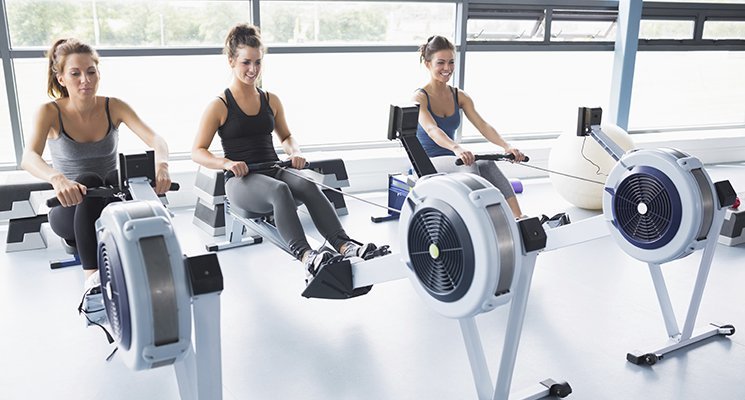
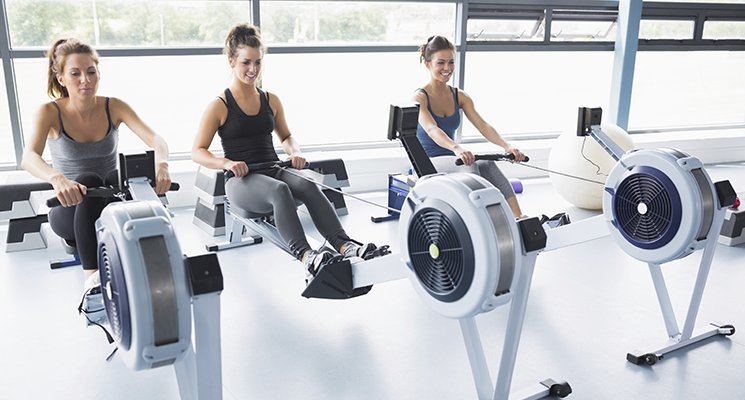
Machines in group workout classes: It’s a trend that started slowly and quietly picked up speed, until all of the sudden it’s everywhere. What began with stationary bikes in the exercise room has exploded into treadmills, rowing machines, stairmasters, and ellipticals in the exercise room, and health clubs around the country are benefiting in terms of both retention and secondary revenue. If you haven’t yet begun offering machine-based group classes, or you haven’t expanded your offerings beyond daily spin classes, it’s time to consider the possibilities.
First, understand what kind of machine-based group workouts your community would be interested in. Take an online poll or ask members to fill out a survey when they walk in. Ask questions carefully: You want answers not only from members already familiar with exercise machines but also from members who do not regularly use them. Ask survey-takers what machines they have used in the past, what machines they might be willing to try, whether they’ve ever taken a machine-based group class before, and what might incentivize them to try one. Once you’ve gathered enough responses, assess the results.
Weigh the insight you gathered from members against your capacities as a club. If the majority of respondents said they’d like to try, say, a rowing class, consider whether you already own enough rowing machines to begin offering such a class. If you don’t, do a cost-benefits analysis to determine whether it makes sense to purchase additional rowing machines. If your members’ responses to survey questions leave you with no clear direction — that is, equal numbers want rowing classes and treadmill classes — you’ll need to decide whether you have the space, machinery, and resources to offer both. If not, you may need to make an educated guess about which one seems more likely to attract members (and new clients).
Next, plan out the logistics. Machine-based class programming is necessarily more involved than other kinds of class programming. You have to know what space in your facility can serve as a dedicated rowing, stairmaster, or other specialty machine classroom. Perhaps the machines you need can be isolated to one side of your cardio room and reserved for forty-five-minute stretches at a few points during the day or week when you offer the class. While this kind of planning is under way, consider what new equipment you might need to purchase, and how you’ll go about doing so. Will you take out bank loans to cover the cost? Will you lease machines? If the latter, what type of lease will you seek? It’s best to start a few direct conversations with both banks and leasing companies so you can decide which option will work best for your facility.
Once you have those details plotted out, try offering mini trial classes. You can consider these market research. If you pitch them to members as focus groups that will allow them to have a hand in shaping the class experience, you’ll likely find enthusiastic participants. After the trial classes, survey participants to find out what they liked and didn’t like. Ask specific questions: Did they appreciate whatever music and lighting effects accompanied the class? Do they have suggestions for improving the instruction? Did they like the warm-up segment of the class? The cool-down? What would they change if they could change anything?
Finally, when you have the form of the class fully figured out-advertise! Post videos, photos, and testimonials on social media sites; paper your facility with informative flyers; give trial participants incentives to spread news of the class by word-of-mouth. Soon you’ll be considering what new machine-based class to develop next and, why it took you so long to set one up!
Jumping on the Machine-Based Workout Trend
Machines in group workout classes: It’s a trend that started slowly and quietly picked up speed, until all of the sudden it’s everywhere. What began with stationary bikes in the exercise room has exploded into treadmills, rowing machines, stairmasters, and ellipticals in the exercise room, and health clubs around the country are benefitting in terms of both retention and secondary revenue. If you haven’t yet begun offering machine-based group classes, or you haven’t yet expanded your offerings beyond daily spin classes, it’s time to consider the possibilities.
First, understand what kind of machine-based group workouts your community would be interested in. Take an online poll or ask members to fill out a survey when they walk in. Ask questions carefully: You want answers not only from members already familiar with exercise machines but also from members who do not regularly use them. Ask survey-takers what machines they have used in the past, what machines they might be willing to try, whether they’ve ever taken a machine-based group class before, and what might incentivize them to try one. Once you’ve gathered enough responses, assess the results.
Weigh the intelligence you gathered from members against your capacities as a club. If the majority of respondents said they’d like to try, say, a rowing class, consider whether you already own enough rowing machines to begin offering such a class. If you don’t, do a cost-benefits analysis to determine whether it makes sense to purchase additional rowing machines. If your members’ responses to survey questions leave you with no clear direction — that is, equal numbers want rowing classes and treadmill classes — you’ll need to decide whether you have the space, machinery, and resources to offer both. If not, you may need to make an educated guess about which one seems more likely to attract members (and new clients).
Next, plan out the logistics. Machine-based class programming is necessarily more involved than other kinds of class programming; you have to know what space in your facility can serve as a dedicated rowing classroom or stairmaster classroom — or, consider whether it’s possible to hold the class right in your current cardio center. Perhaps the machines you need can be isolated to one side of your cardio room and reserved for forty-five-minute stretches at a few points during the day or week when you offer the class. While this kind of planning is under way, consider what new equipment you might need to purchase, and how you’ll go about doing so. Will you take out bank loans to cover the cost? Will you lease machines? If the latter, what type of lease will you seek? It’s best to start a few direct conversations with both banks and leasing companies so you can decide which option will work best for your facility.
Once you have those details plotted out, try offering mini trial classes. You can consider these market research. If you pitch them to members as focus groups that will allow them to have a hand in shaping the class experience, you’ll likely find enthusiastic participants. After the trial classes, survey participants to find out what they liked and didn’t like. Ask specific questions: Did they appreciate whatever music and lighting effects accompanied the class? Do they have suggestions for improving the instruction? Did they like the warm-up segment of the class? The cool-down? What would they change if they could change anything?
Finally, when you have the form of the class fully figured out, advertise it like crazy. Post videos, photos, and testimonials on social media sites; paper your facility with informative flyers; give trial participants incentives to spread news of the class by word-of-mouth. Soon you’ll find yourself wondering why it took you so long to set one up, and you’ll be considering what new machine-based class to develop next.
ACE Urges Congress to Focus on Prevention
Recently, the American Council on Exercise (ACE) submitted a letter to Congress, urging the governmental body to redefine the U.S.’s approach to healthcare. Rather than focus on treating people who are ill, our healthcare system should emphasize illness prevention, ACE argued, while also empowering sufferers of chronic disease to manage their discomfort. As the letter put it: “[O]ur healthcare system needs to shift from one almost solely focused on responding to people who are ill to investing in preventing people from getting sick in the first place and empowering those with chronic conditions to helping themselves when they can.”
Among the intriguing policies that ACE enjoined Congress to adopt is this one: “Allow for financial incentives through tax policies to encourage increased participation through physical activity to reduce the chances of incurring preventable chronic diseases.” What this amounts to in plain English: “Reimburse people who pay to work out!”
In addition to benefitting large swathes of the population, ACE’s proposed financial-incentives plan could, of course, have beneficial effects for the fitness industry. The plan is ingenious. If individuals are reimbursed through tax policies for payments they make to gyms, sports centres, and other fitness facilities, then those individuals will have the opportunity to work toward better health at a lower cost. The facilities they sign up with will enjoy the benefits of a growing membership along with, ideally, built-in incentives for members to stay on-board. And, as citizens become healthier, managing their chronic illnesses and preventing the onset of new disease, the government, over the long term, will begin to see the overall cost of healthcare fall. Everybody wins.
Other proposals in ACE’s letter are equally hopeful. “Make science-based, interdisciplinary coaching, counseling, and support for sustainable behavioral change a functional, integral component of the nation’s healthcare system.” Elsewhere in the letter, ACE describes its members as “advocates for extending the clinic into the community with science-based preventative services delivered by well-qualified professionals not necessarily thought of as healthcare providers.” Put these two together, and you have a movement to enable greater health and healthier decision-making through the involvement of a population of workers not as overburdened as doctors and other medical professionals but qualified to provide health-related guidance — that is, personal trainers, nutritionists, physical therapists, masseuses, and others who make the fitness industry their home.
Another policy ACE pitched to Congress articulates this even more directly: “Extend the healthcare team into the community by tapping well-qualified health and fitness professionals to deliver preventative services and programs focused on behavior change directly in the community, reimbursable by health insurance.” A side benefit of a policy like this one is that health and fitness professionals could be held in greater esteem by the population at large, their knowledge and their services valued for the truly life-transforming elements they are.
All in all, ACE’s letter to Congress is one to read, promote, and actively support. As one of those health and fitness professionals who stands to benefit so much, call your local Congressperson and make your feelings about the letter known. Echo ACE’s words: “The single most effective path to manage rising healthcare costs is to reduce the cost of managing choric disease.” Then explain how your work has proven to you over and over again the truth of this statement.