iStock_000021232510Small.jpg

Competing with the Home Gym

« Blog | Written by ezfacility | | (0) Comments |

As winter is a time for hunkering down, it seems appropriate that I haven’t been able to get myself to the gym for several weeks now; all I want to do is curl up under a blanket. I have, however, managed to find a few exercise podcasts and videos and start working up a sweat in my home office. I know I’m not getting quite the level of exercise I need: no equipment, no trainer, no instructor, no fellow sufferers. But it’s hard to kick my own rear in a gym-ward direction when I know I can get at least some sort of workout at home.

I’m not the only one. I have a couple of friends who swear by the stationary bikes in their living rooms; one guy I know has an entire weight room in his basement. And recently the Wall Street Journal reported that, while sales of traditional home fitness equipment have declined in the past few years, and while the percentage of Americans with gym memberships has pretty much held steady, sales of lower-priced fitness items, like yoga mats and workout DVDs, have increased. The fact is that sometimes fitness centres are competing for customers not only with other fitness centres, but also with those customers’ personal spaces. What can be done to pull people — yes, people like me — away from the yoga blocks in their closet or the medicine balls in their bedroom and into the gym?

The key is to offer benefits that outweigh the benefits of working out at home. The way I see it, working out at home has three major benefits: It saves money, it saves time, and it’s oh-so-convenient. But I know that going to the gym instead of exercising at home would get me to my fitness goals faster. There, I can use equipment that much more efficiently burns fat and increases muscle than anything I can do at home. More importantly, I can call upon the expertise of trainers and instructors who can show me how to position my body just right or explain why I’m at risk of injuring myself if I’m performing reps incorrectly.

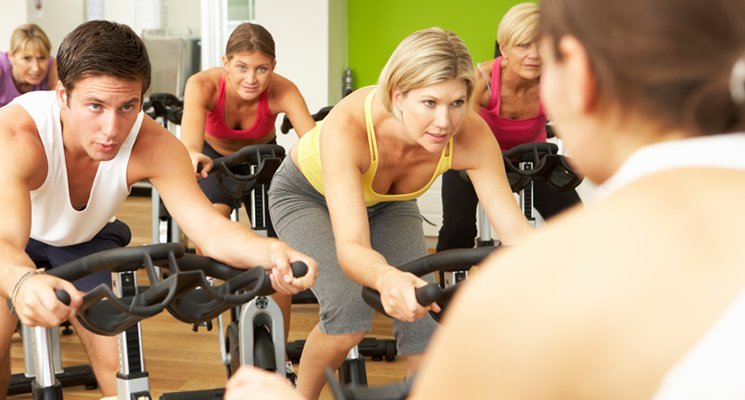
But the best thing, the thing I most lack at home? External sources of motivation. No matter how great the podcast I’m streaming might be, it’s nothing compared to the rush I get when I’m trying to run faster than the guy on the treadmill next to me, or the comfort I feel when I mess up a Zumba move and a sympathetic classmate tells me not to worry about it, or the simple satisfaction that comes from not being the only one, all alone, trying to keep myself healthy and live right.

So your task as a health club owner or manager is to remind me why I’m better off at the gym. Have your fitness concierge (you have one, right?) send out emails to folks like me to tell us what the gym can offer us that we can’t get at home. Post videos on social media that show me other people who managed to get themselves to the gym that day. Even ask one of your trainers to call and check in on me — you can bet that being held accountable by someone I’m eager to please is going to finally get my butt out the door. I know I’m saying the onus is on you, but that’s really how it is. You got the gym up and running; it’s your job to get me coming to it.

Keep in mind, too, that you actually can compete directly with some of the home-based workout benefits. Given that convenience is a big factor, you can offer special deals to people who live close to your facility — within a few blocks, say, or within a mile or two. You’re convenient for at least some people. Make it your business to make sure those people know it. And given that saving time and money is a big factor, you can consider offering winter discounts and designing (and widely advertising) super fast classes, ones that get members in and out of the gym in under thirty minutes.

It might be hard to lure people like me out of our houses before the crocuses start blooming and the birds start singing, but it’s not impossible. Make it worth our while.

Extreme Sports Complex Planned for Florida Locale

« News | Written by ezfacility | | (0) Comments |

A Florida-based development group has launched plans for an extreme sports action park in Kissimmee, Florida. The park, dubbed The Xero Gravity Action Sports and Entertainment Resort, will include a 14-story ski and snowboard slope, a 25,000-square-foot indoor/outdoor skateboard arena, a USA-BMX-sanctioned racetrack, two sky-diving pods, two 14-story water slides, an indoor dodge ball trampoline court, a 140-foot-tall climbing wall, a river of white-water rapids, and multiple zip lines.
“Extreme sports and sports tourism are booming sectors of the fitness industry,” says Eric Willin, Chief Operating Officer of EZFacility, a sports facility management software developer in Woodbury, New York. “This is exactly the right moment for a park such as the Xero Gravity Action Sports and Entertainment Resort, and, given the other attractions in the area, the proposed location makes good business sense. This is going to be a sports complex to watch.”
The estimated cost of the complex is $309 million, and it is slated to open in 2018. Projected taxable sales for the proposed complex are estimated to be $1.97 billion over a 10-year period. Reportedly, admission to the park will cost between $35 and $95.

front desk help

Easing Rush Hour

« Blog | Written by ezfacility | | (0) Comments |

No one likes rush hour. The crowds, the slowness, the general irritation of having other people block your way — given the choice, most people would go far out of their way to avoid it. In fact, in a recent study by The Retention People, researchers found that the one complaint members of top-performing clubs have most often is that the clubs are too busy at peak times. This, of course, is good news for clubs: Too busy equals successful. But you have to balance that kind of success with retention. If your members become fed-up with crowded spaces and inadequate facilities, they might choose to leave and you’ll be stuck watching your retention rates sink.

Unfortunately for members, many of them do not have a choice about avoiding rush hour. They work regular business hours and tend to families, and that leaves few options for hitting the gym: before work, during lunch, or after work. In other words, rush hour. So what can you do to improve the rush hour experience for your members?

Interestingly, The Retention People study asked members a single question: On a scale of 1 to 10, how likely is it that you would recommend your health club to a friend or colleague? Respondents were categorized according to their ratings: “Promotors” gave their clubs a rating of 9 or 10, “Passives” a rating of 7 or 8, and “Detractors” a rating of 0 through 6. Respondents also were given the option of explaining their answer. Researchers then used scores and common phrases to identify issues. As far as the rush hour problem goes, some of the words detractors most commonly used were “crowded,” “changing rooms,” and “equipment,” in explaining their reasons for responding negatively. If you’re looking to improve rush hour, these are the areas you should focus on.

• Crowded: Assess the space in your facility. In particular, watch the flow of traffic into and out of the facility during peak times. Do customers wait in line to reach the front desk? If so, increase your front desk staff or consider whether you need to make staff changes. If employees are not the issue, is there another way to increase efficiency up front? Can you install automatic card readers (if you don’t have them already), so members can flash their IDs and go? What about other spaces in the facility? Where are the crowds? How can you even them out?

• Changing rooms: Assess your changing room areas. First of all, do you have the resources to expand them? If not, can you do a redesign? Ideally, of course, you want changing rooms to offer plenty of locker space, wide aisles for a free flow of traffic, and enough showers, bathroom stalls, and dressing-room spaces that customers never feel like they’re being made to wait. If your changing rooms are cramped or inadequate and reconstruction isn’t an option, can you designate secondary changing rooms (such as family rooms) for specific groups during rush hour only? Can you hire more attendants to ensure smoother operation?

• Equipment: Again, you need to assess your situation: Do you have enough desirable equipment — and enough space for it — that members never feel like they’re waiting for the treadmill, medicine ball, stationary bike, or whatever other item it might be that they want to use? If not, can you acquire more of the most sought-after pieces of equipment? Can you impose a rush-hour only time limit on those pieces?

It’s going to be impossible to give everyone everything they want during rush hour. Some members will have to wait sometimes. Some will have to grudgingly deal with time limits. Some will get fed up and leave. But if you can reduce the chances of losing members, it’s worth trying to do so. One other interesting thing to note about The Retention People study: Promotors at top-performing clubs — that is, members who rated the likelihood of their recommending the club to others very high — said that what they like about their club is the “fantastic staff”, “great service”, and “friendly team.” If reducing the rush hour crunch is too challenging, then you can always compensate with supreme customer service. That goes a long way toward solving every problem.

Minnesota Vikings Stadium First in U.S. To Launch With LED

« News | Written by ezfacility | | (0) Comments |

The Minnesota Vikings stadium stands to be the first stadium in the United States to illuminate its fields with LED installed during construction. With lower energy needs than traditional lighting and colour-tuning technology, LED saves sports venues and other facilities significant amounts of money while providing more effective lighting.
The lighting has become a common feature of ice rinks in the American Hockey League, and tennis, basketball, and soccer facilities have long made use of it. But venues in the National Football League have been slow to embrace it. So far, two NFL stadiums have converted to LED — the University of Phoenix Stadium, home to the Arizona Cardinals, and the NRG Stadium, home to the Houston Texans. The Minnesota venue will be the first to incorporate LED from inception.
“There are many potential advantages to lighting a sports venue with LED,” says Eric Willin, Chief Operating Officer, of EZFacility, a sports facility management software developer in Woodbury, New York. “On a basic level, spectators often can just see better what’s happening on the field. In addition, LED lights have more functions than older lights—they can be programmed for specific effects throughout a game. But most of all, LED lighting consumes 75 to 90 percent less energy than traditional lighting systems. That’s good for the environment and translates into enormous cost savings.”
Viking officials have said that part of their goal during the $1.1 billion project has been making environmentally friendly choices. Currently in the planning phase, the stadium is slated for completion in July 2016.

sauna and spas

Getting Green While Getting Clean

« Blog | Written by ezfacility | | (0) Comments |

We’ve talked before in this space about going green: making small changes to everyday practices in order to create more eco-friendly athletic and fitness facilities. We’ve talked about making big changes too: about using sustainable building materials and developing lighting, heating, and cooling strategies that leave smaller environmental footprints. One thing we haven’t talked about, though, is laundry. That’s why I was glad to see a great article about athletic laundry facilities on Athletic Business’s website.

The article points out the complications of working at an athletic laundry facility: the use of multiple fabric types in sports uniforms (today’s uniforms typically comprise five different types); the need to have a constant supply of towels available on demand; the expectation that workout clothes and other gear will be clean and ready whenever needed. Given the high-pressure environment, it’s not surprising that ecological efficiency is not the first thing on a laundry room’s agenda. But the laundry room is a place where a huge footprint can be left. From massive amounts of water, to massive amounts of energy used to power the water, to the chemicals required for those complicated cleaning jobs, athletic laundry rooms present big challenges to the “go green” effort.

So, if you run an athletic facility — or a fitness center with a laundry room for processing copious towels — what can you do to strive for greater eco-efficiency?

Start with the water. As the Athletic Business article notes, using programmable-control machines that automatically choose appropriate water levels for different wash jobs reduces human error in water consumption. Also, filling machines with appropriately sized loads makes a big difference. Most people underload, Gary Gauthier, a regional sales manager with the Pellerin Milnor Corporation, told Athletic Business. “This practice,” he said, “wastes water, chemicals, energy, and time.” What’s an appropriate load size? “I encourage that frontloading washer-extractors be filled until there’s a football-sized opening at the top of the basket,” Gauthier said. Other possibilities to consider: washers that have shower-rinse features along with bath-rinse features, washers that use polymer beads or other new technologies in place of most water, and washers that allow you to reclaim the water used for rinsing.

Next, think about chemicals. Taking steps to conserve water is just the beginning. Choosing the right chemicals also goes a long way toward reducing environmental impact. Cold-water chemicals that clean fabrics effectively save on costs associated with heating water. Ozone, a chemical less harsh than chlorine and equally effective in smaller amounts, disappears as it cleans and loosens fibers for softer, cleaner items; it also has the added benefit of conserving water because it requires less to get the job done. Whatever chemicals you choose for your facility, laundry experts recommend building up a good working relationship with your chemical representatives. “A knowledgeable chemical rep who can visit the laundry locally and solve cleaning issues is an ideal resource for any athletic facility,” Gauthier told Athletic Business.

Finally, review your laundry facility’s operational efficiency regularly. With continually updated uniforms, new styles of towels, changes in practice gear and equipment, and other frequently changing variables in the laundry room, it’s essential to keep your laundering practices up-to-date. Otherwise, it’s easy to keep cycling through routines established in past years (or even decades) without pausing to consider whether those routines are still relevant. Reviewing your operational efficiency allows you to analyze data related to towel loads, water usage, chemical optimization, and much more, and to make decisions related to your analysis. In other words, don’t let the laundry room operate on autopilot. Take charge of the controls, and you’ll find yourself with a more sustainable facility — and maybe even cleaner clothes.

Expansion of UCCS Recreation and Wellness Center Doubles Facility’s Size

« News | Written by ezfacility | | (0) Comments |

The University of Colorado, Colorado Springs (UCCS), is expanding its Recreation and Wellness center in a $16.3 million project scheduled for completion in October. Currently 54,000 square feet, the renovated center will be nearly twice that size and will include additional cardio and strength equipment, multipurpose studios for group exercise, basketball courts, new men’s and women’s locker rooms, two gender-neutral restrooms, office space, a social gathering area, and a welcome center.
In addition, the facility will house a student health center and counseling center. According to UCCS officials, the facility will be the first in the nation to pull together campus recreation, a student health center, a counseling center, and elements of nutrition education under the same roof.
“More and more, especially at universities, we’re seeing a trend toward comprehensive centres that include athletic facilities, general exercise areas, and various health and recreation services,” said Eric Willin, Chief Operating Officer, at EZFacility, a fitness center management software developer in Woodbury, New York. “Bringing all these functions together makes sense, and it provides an exciting dynamic surrounding health and wellness efforts on campus.”
The existing center has been lauded for its LEED gold rating, achieved through an environmentally friendly design and construction. The expanded center also has been designed to meet LEED gold standards. Its green elements include water-efficient landscaping, on-site storm water treatment, and use of local and recycled materials in construction. An on-site touchscreen shows real-time measurements of building energy use.

business keywords

Matching Future Goals with Software Solutions

« Blog | Written by ezfacility | | (0) Comments |

When it comes to facility management software, it can be difficult to know what product will be a good fit for your company. What features do you assess in order to make a determination? How can you know, before putting money down, whether a given product will be right for you?

One factor that can set a product apart from others is what is planned for it in the future. As Athletic Business magazine put it in a recent article, “What are the vendor’s future plans — and yours? Given how rapidly technology is evolving, this might be the most important question to ask once you have your priorities in mind.” The question is crucial not only because of the pace at which technology changes but also because, as a business, your facility must grow in order to thrive. If you invest in a software solution that will not grow with you, you’ll find yourself in a few years having to choose a new solution all over again — or having to figure out how to live with an inadequate one.

To understand what a vendor plans for a software product’s future, you need to know two things: what additional features a company has in development and how your own needs might change. In talks with salespeople, ask what features the vendor plans to implement in the future, and when implementation is expected to happen. Some particular features to consider inquiring about: mobile compatibility (if the software doesn’t already have a mobile feature, will it? Will it work on all devices?), simplified registration for and checking into group fitness classes (will the software solution allow for one or two clicks that let members efficiently register or check in?), encryption techniques (will software updates include whatever encryption technologies are most cutting edge at the time?). Also, think about your particular future needs. If you’re a college rec center, perhaps you plan to offer occasional outdoor adventure programming — does the software solution you’re considering allow for this, or might it in the future? Are you considering implementing wearable integration, and, if so, can the solution support this?

Clearly, you need to undertake some self-reflection before you begin asking about the future of a given product. If you haven’t already, sit down with your core team and brainstorm how you want the next five years — and the next ten and fifteen and twenty years — to look for your facility. What’s your wishlist in terms of general development and growth? What do you imagine for your facility particularly in terms of technological implementation? What do you hope your management software will be able to do for you down the road? Once you articulate answers to such questions, you can begin to understand the kinds of questions you need to ask about management software products. Don’t be afraid to get carried away. If you envision eventually have a sixty-foot rock-climbing wall that ascends from the deep end of a swimming pool, but you currently have no wall and no aquatic center, make sure your management software package either has the capacity to handle a climbing-wall-cum-swimming pool or will have it. Anything you can project as a possible reality for your facility, you want your software to be able to handle — if not now, then at some point.

So think ahead, think big, and ask questions about what’s to come.

For-Profit Adult Sports Leagues Increase in Popularity

« News | Written by ezfacility | | (0) Comments |

A new trend is keeping adult millennials — the generation of Americans born roughly between 1980 and 2000 — in good shape: for-profit businesses that run adult sports leagues. Popping up around the country, such businesses set up teams, arrange for referees, and coordinate practice and game sites. Customers sign up as part of a team or as free agents, with costs running anywhere from $50 per person to $90 per person for a season.
Eric Willin, COO of EZFacility, a sports business software provider in Woodbury, New York, says that such for-profit leagues are a natural fit for millennials. “Members of the millennial generation tend to have grown up with schedules packed with extracurricular sports,” he says. “They learned to develop social circles through the sports they played, and they miss the physical exercise plus socializing they got through the organized teams they played for. It’s no surprise that this group is enthusiastic about competing in adult recreation leagues, and no surprise that the supply is developing to meet the demand.”
Valley Sports Leagues, in Parkland, Pennsylvania, is one company that organizes adult leagues. Operated like nonprofit youth sports groups, it coordinates teams playing a range of sports, including men’s and women’s basketball, flag football, dodgeball, and kickball. Ahmed Attia, one of the co-founders of Valley Sports Leagues, told the online publication The Morning Call, “If we could help an individual switch lifestyles to a healthier one, that’s really what we try to target. It’s kind of hard to not show up when you have teammates counting on you.” The idea that customers will seek a structure that holds them accountable to teammates is what drives for-profit adult leagues.
In general, millennials are much more receptive to this idea than are Gen-Xers, members of the preceding generation. According to Sports Marketing Surveys USA, a research company that provides data for the Sports and Fitness Industry Association, millennials are twice as likely and their Generation X counterparts to participate in team sports as adults.

sporting event fans

Making Special Events a Revenue Stream

« Blog | Written by ezfacility | | (0) Comments |

Looking for ways to create a new revenue stream or beef up an existing one? Look no further than the space all around you. It’s all you need in order to pull in earnings over and above what you make through membership dues.

I’m talking about special events. You have the space. Chances are you have open time slots too. Given these, you have the opportunity to invite community groups, families, schools, and anyone else you can think of in for one-off or recurring events. You just need to figure out how to position yourself as the place to call when someone is looking for event space.

From an event planner’s point of view, pricing is probably the top concern. What you can reasonably charge probably depends a lot on where you’re located — there are facilities in Manhattan that charge upwards of $5,000 just for a kid’s birthday party; joints in small towns probably couldn’t get away with quite so much. Do some research and see what the going rates are in your area. Then figure out how little you can afford to charge. I know that sounds anti-intuitive, but the fact is that if your facility’s primary function is to provide lessons, leagues, games, coaching, and the like, maybe you can consider anything that comes in from special events extra. Keeping your fees low can help make you the most appealing place in town.

On a related note, don’t get hung up on providing extras. Keep those fees low by offering the minimum that groups and families need in order to create their own fun: a space. Maybe a space and a couple coaches, some sports equipment. Too many facilities think they’re competing with other kinds of venues that go all out providing decorations, food, entertainment, and the like. You’re not that kind of venue; you’re a sports center or health club with some space to offer. And many event planners want to choose their own extras anyway. If you feel you must offer more, think about devising package plans: space plus extras for those who want a “just-the-facts” option for those who don’t.

But do be sure to offer incentives. Give free passes to classes, practices, and training sessions to event planners; offer them the chance to secure the space a second time for half price. Brainstorm whatever other kinds of incentives might work best for your facility. And while you’re at it, don’t forget to see the event as a marketing opportunity. Ask your event organizers if you can hand out flyers during their events — or, better yet, flyers with coupons attached. Let everyone who comes know what kinds of classes and services you offer. And, most importantly, make sure you are pulling reports on sales of these programs and offers in your club management software.You will want the physical proof of your progress! If you do it right, special events can be more than just a revenue stream — they can bring you new members and clients, too!

puzzle piece

Helping Your Members Find Their Own Way

« Blog | Written by ezfacility | | (0) Comments |

I have a confession to make: Exercise bores me. Don’t get me wrong — I love staying fit, and I love the way I feel after a great workout, but no matter what exercise routine I try, after a while I get bored and want something new. For a while I was into spin classes. Then it was Zumba. Then aquatic aerobics, HIIT-style repetitions, and just plain jogging. Now I’m all about indoor climbing. I was starting to think there’s something wrong with me, but then I stumbled across a post on the “Be Active Your Way” blog, a publication of the Department of Health and Human Services. Written by Alexandra Black, a dietician and IHRSA’s Health Promotion Manager, the article is not about keeping exercise interesting — but it nevertheless put my mind at ease and inspired me to continue trying new routines.

What the article is about is this: using trial and error to determine the best workouts for individuals. “Each person,” Black writes, “has a unique genetic makeup, different life experiences, and varied medical histories that make it nearly impossible to prescribe one great diet or one great fitness plan for all.” Because of this, she says, the best way for individuals to figure out what works for them is through trial and error. The health and medical industries are beginning to recognize this, and the result of moving away from a one-size-fits-all mindset is better care and better long-term health for people. Black puts it this way: “As the trend towards individualized healthcare continues, we’re recognizing that every person is different, and that treating them as such — both in healthcare and in wellness — is often where the real magic happens.”

Which brings me back to my boredom issue. Reading Black’s thoughts on trial and error made me realize that the only way for me to find a routine that doesn’t eventually bore me is to keep trying new ones — and that it’s okay to do so. Maybe I just haven’t found the right one yet, and I need to keep searching until I do. Or maybe it’s the case that my genetic makeup, life experiences, and medical history make me a person who needs constant changes in her workout routine in order to most benefit from working out. Whatever the case, thinking about fitness as something that requires an individualized approach completely changes the way I think about working out. It gives me a feeling that I have permission to keep trying whatever I want to try.

Why am I sharing all this? Because chances are that an individualized fitness approach is something that would appeal to your members too. Of course, if you have personal trainers or some kind of personalized workout program, you already promote individualized fitness — but doing so explicitly could put your members at ease (enough so that they renew their memberships and talk your facility up to all their friends and social network connections). Defining individualized fitness and explaining its benefits — through posters, emails, social media, and one-on-one sales and promotion pitches — can help your members feel freer to engage in their own trial and error, giving new workouts and exercises a try, experimenting until they know what works best for them. And helping them in that way greatly increases the chances that they’re going to keep coming back to you.