Brand identity

Your Mission: To Think About Mission Statements

« Blog | Written by ezfacility | | (0) Comments |

Recently, a post on IHRSA’s blog gave me pause. It features Fred Hoffman, owner of Fitness Resources in France, and it focuses on the relationship between personal trainers and member retention. What struck me is that Hoffman talked only a little about that relationship; what he emphasized is the importance of mission statements. As he put it, “Policies, procedures, performance standards—all should be based on [a] company’s mission statement and represent its core values.”

This got me thinking. Really, what is a mission statement? Hoffman argues that “whatever takes place in a club is a reflection of the company and its management.” In this conception, a mission statement is like a mirror you hold up to your club to make sure that it looks the way you want it to look. If you glance into the mirror and what you see doesn’t match your ideas about what you should see, then you know it’s time to make changes. If you don’t have the mission statement—don’t have the mirror—then you have nothing against which to compare your reality, nothing by which to judge how close your reality is to meeting your ideal. How then do you know what to change? How do you assess the “whatever takes place in your club” to ensure that it is a true reflection of your company and its management?

So, as Hoffman says, “If you have a mission statement, revisit it, and, if you don’t, draft and fine-tune one.” Your mission statement should do several things:

• Provide an explanation of what your club does

• Include a description of your corporate culture

• Incorporate examples to show how your corporate culture manifests itself

• Enumerate your club’s core values

• Explain how the core values are used to obtain desired results for members, staff, suppliers, and the business as a whole

Thus, it’s not enough to state your goals. As they say in the journalism business, “specific is terrific”: You need to explicitly state what you are, what you do, what activities and attitudes define you. You need to provide concrete examples, avoiding abstract language that ultimately doesn’t mean much. And you need to pull it all together to show how you accomplish everything that you want to accomplish.

How then do you use the mission statement, in practical terms? During your hiring process, share it with potential employees. Make sure that they understand it. If it doesn’t make sense to them, or if they can’t see how it forms the basis for everything the club does and every decision management makes, they might not be the right employees. If they do understand it, make sure they see how the role they would play within the club aligns with it. To use the personal-trainer-and-retention example, if one of the core values your mission statement outlines is member retention, make very clear how the responsibilities set forth in the job description relate to member retention. Show how each core value jibes with the various job responsibilities described.

Finally, make sure employees never forget the mission statement. There’s a reason why grade school children used to have to recite the Pledge of Allegiance every morning. You don’t have to make your employees recite the mission statement daily, but do post it prominently in a staff lounge. Do bring it up during staff meetings. Do discuss it with employees when you meet with them one on one. If your employees see how important the mission statement is to you, they’ll believe how important it is to them.

Keeping Your Facility Germ-Free-- And Your Members Happy

Keeping Your Facility Germ-Free—and Your Members Happy

« Blog | Written by ezfacility | | (0) Comments |

In 2008, IHRSA published the Guide to Health Cleanliness, which highlighted the startling results of a survey: More than 90 percent of survey participants said they were more apt to renew their membership with a health club facility if the facility was clean. That might not be so surprising, but here’s the shocking part: Only slightly more than half said they would renew if the facility was not clean.

Keep in mind that this was six years ago, before the Ebola scare, before enterovirus D68, before super-strong strains of the flu were floating around. With these threats around us, and with media hype that frequently blows such threats out of proportion, it’s little wonder that health club and sports facility users are even more cautious than they used to be. Add to that the fact that we’re smack in the middle of cold season, and you’ve got potentially a lot of skittish members on your hands who want assurance that their health is protected when they’re using your facility.

What can you do to reassure them? First of all, make sure you’ve got a plan for keeping your place as clean as possible. Review your cleanliness policies and procedures. Are they up to date? Do they follow best practices? Are they generally in keeping with standards set by the Centres for Disease Controls (for example, wash hands with soap and water for 20 seconds or rub an alcohol-based sanitizer on hands for 15 seconds before and after workouts; shower after workouts; avoid walking barefoot across exercise floors and locker rooms)?

After you’ve polished up your policies, start thinking about your staff. Do they know the policies? Do they know what to do if they’re sick (best practices say they should stay home)? Do they know what tasks they should take responsibility for in order to help maintain the highest standard of cleanliness possible? Organize a mandatory staff meeting solely around these issues and make sure everyone is on board. Do frequent walkthroughs with a cleanliness checklist to make sure rules are being adhered to.

Finally, communicate directly and explicitly with your members about cleanliness in your facility. Send out an email explaining your concerns during the season, highlighting the steps your club is taking to stay as germ-free as possible, and asking members to remain aware of ways in which they can help contribute to a cleaner club environment. List specific tips, like the Centres for Disease Control standards shown above. A post on IHRSA’s blog describes an email Newtown Athletic Club recently sent to its members. Linda Mitchell, Newtown Athletic’s director of PR and Marketing, devised a letter with the subject line “Healthy Facilities Initiative.” She and her team carefully worded the letter, avoiding making any promises but being sure to explain procedures. They assured members that maintaining a clean facility is a top priority. Then they described new procedures being implemented and outlined member responsibilities. Mitchell told IHRSA that the email had an unheard-of 35 percent open rate—to her a clear indication that members were hungry for information about facility cleanliness.

Ultimately, you want to make your members feel secure, and you want them to know you welcome their questions and can answer them satisfactorily. Over and above that, you want to keep your facility as germ-free as possible — for your members’ sake, but also for your own and your staff’s. Provide a safe environment, clearly communicate the details about how you’ve done so, and keep everyone feeling strong and healthy all winter long.

Transform Your Space—And Maybe Even Your Identity

Transform Your Space—And Maybe Even Your Identity

« Blog | Written by ezfacility | | (0) Comments |

So, you own an ice arena and you worry about lost revenue in the summer. Or, you run an indoor soccer facility and you can’t justify having all soccer, all the time. Or, sometimes you just wish your basketball court had turf. Well, put your mind at ease, because it can. According to an article in Athletic Business magazine, there’s been a recent boom in portable synthetic turf, and new, updated models have hit the market just in the past six months. As the article puts it, “The turf is temporary by design, boasting an ability to be rolled up, removed and later reapplied, or…stacked and stored for future reconnection.”

Portable and temporary turf—it’s a game changer. Manufacturers like AstroTurf, FieldTurf, Ecore, and others report to Athletic Business that demand for the product has exploded. The business director at one such company, Sporturf, said, “It’s one of the fastest-growing segments of our business… The upfront cost to purchase this turf is minimal compared to the cost of [a] facility just sitting there empty.”

Many different kinds of facilities are employing the product these days, from Houston’s Reliant Stadium—which removes natural grass on which the pro teams play to lay down synthetic turf for high school games—to independent personal training spaces, where, facility owners might want some weight-room flooring on one side and some turf on the other. The Edward Jones Dome in St. Louis, Lucas Oil Stadium in Indianapolis, the Milwaukee Wave’s Major Arena Football League—all these are big-time facilities that regularly use temporary turf to change their floor surface depending on the changing needs of various players.

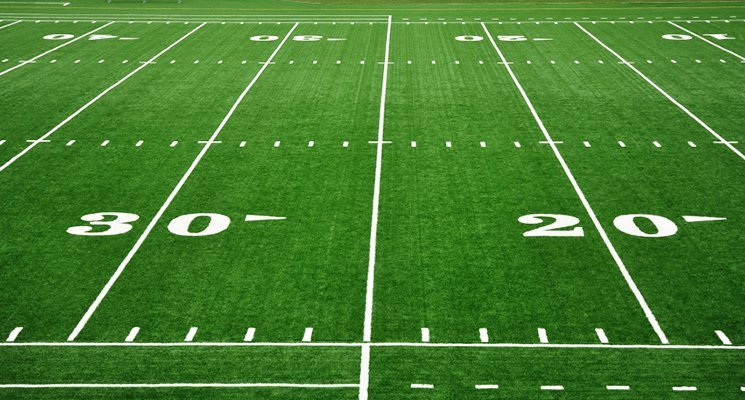
Interested in portable turf for your own facility but not sure where to begin? Keep in mind that the product comes in two basic forms: rolls and panels. Rolls can vary in width, with some of them measuring 15 feet wide and 200 feet long—great for creating an instant football field. The gigantic ones can be massive enough to require heavy machinery during installation and removal (but even with the cost of machinery factored in, the product saves money in the long run). Panels tend to range in size from seven and a half square feet to 32 square feet, depending on the manufacturer. These can be installed and uninstalled relatively easily, with just a couple of employees—or players—handling even the largest ones. Some temporary turf is held in place with heavy-duty Velcro. Other versions fit together with peg-in-hole fasteners or puzzle-like interlocking edges.

On the whole, manufacturers see portable turf as a way for smaller venues to maximise programming. Consider how such a product might help you maximise your own programming. With a temporary turf surface, could you hold drills for sports teams you’ve never before imagined hosting? Could you keep your facility running for an entire season during which you usually shut your doors? Could you expand your offerings and thereby revolutionize your entire brand identity? With a product that has the power to transform both your physical space and your customers’ ideas about you, it’s worth considering exactly how you might make use of it.

Rethinking Reception Areas — in Real Life and Online

Rethinking Reception Areas—in Real Life & Online

« Blog | Written by ezfacility | | (0) Comments |

We all know the cliché: First impressions matter. Some social scientists have suggested that we size up new people, places, and things within thirty seconds of first encountering them, making decisions about them then and there. Of course, first impressions often are proven wrong — but sometimes, depending on the content of a given impression or the person forming it, there’s no chance to prove it wrong. Fact is, clichés are clichés for a reason: They tend to touch on some kind of truth. In the fitness and sports facility industries in particular, first impressions really do matter. Potential members might decide in a split second whether to sign up with your facility or not.

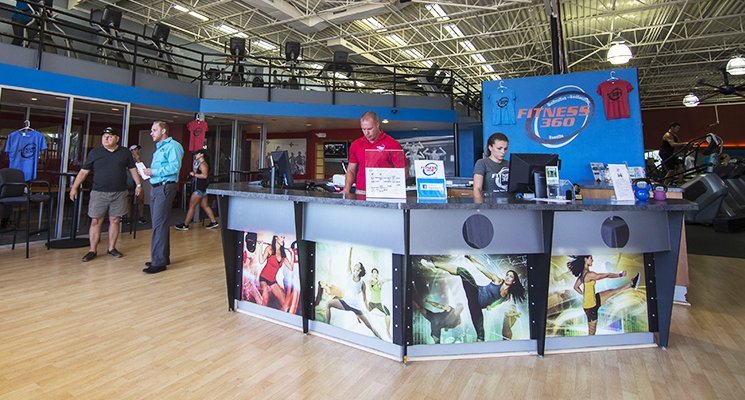
What gives someone a first impression of your organization? Your reception area, of course. Or, I should say, your reception areas, because in this day and age you likely have two: a virtual one and a bricks-and-mortar one. If you want to sell memberships effectively, you have to consider both carefully.

Let’s think first about the old-fashioned one, the bricks-and-mortar reception area. Remember, this space represents a transition from the outside world — that is, the world that contains a potential member’s stressors, responsibilities, and aggravations — to your facility. How do you want people who walk through your doors to experience that transition? Chances are, you want them intuitively and immediately to grasp that they’re entering a sanctuary, a safe harbor that will hold the stressors, responsibilities, and aggravations at bay. The more they feel that, the more likely they are to keep coming back. In other words, you want your reception area, that first-impression space, to do the work of fulfilling what are likely two of your facility’s main goals: signing up new members and retaining existing ones.

How do you accomplish this? First, ask yourself how warm, welcoming, and calming your reception area is. Is it a carefully designed space, with colours, lighting, fixtures, and signage that let people know you want them there, you’re friendly, and they can relax? Maybe you have a fountain, plants, yellow lighting angled just so. At the same time, is the space energizing enough to help people get into a workout mindset — a splash of bright colour on one wall, say, an image that suggests intensity and power? Does it look generic, as if a person standing there could be anywhere, or does it look like it could be only one place in the world: your facility, reflecting your identity? Do your front desk employees smile? Do they know members by name? (Of course, needless to say, the space should be uncluttered and impeccably clean.)

If you answered no to any of these questions, it’s probably time for an overhaul. An architect or interior designer can help you get started. One step you can take right away is researching current design trends for fitness and sports facility reception areas — and then being sure to avoid them. Part of the first impression you want to aim to create is the sense that your place is different, in a category all its own.

Now, what about your virtual reception area, a.k.a. your website homepage? In the old days, of course, this wasn’t something a gym owner or manager had to worry about. But the fact is that nowadays, people form an impression of your facility before ever stepping foot into it, and they do that by looking you up online. Take a good, hard look at your homepage ask yourself some questions. Some of the questions are similar to the ones you want to ask about your physical space: Is it warm? Is it welcoming? Does it set you apart from other facilities? But you also want to consider the following: Does the page load quickly? Does it avoid being overly busy? Does it reflect and reinforce your facility’s brand identity? Does it efficiently answer questions people are likely to ask, or provide obvious links to answers?

A final key point to keep in mind: Online impressions are formed not only through your facility’s webpage, but also via reviews on Google, Yelp, personal blogs, and other such pages. If you’re concerned about potentially negative impressions these kinds of sites might leave, or if you just have no idea how to begin approaching the issue, consider hiring an online reputation expert, someone who combs through existing pages about your business and strategizes ways to emphasize the good stuff.

Row class

Creating Space for New Fitness Fads

« Blog | Written by ezfacility | | (0) Comments |

When I was in college, there were two stationary bikes in the gym’s cardio room. One of them had a tiny little screen that allowed you to set the number of miles you wanted to log or the amount of time you wanted to exercise; it also had a primitive graphic, like something from an Atari 2600 video game, that let you visualize your course: up “hills”, down “valleys”. That was the high-tech bike. The other one had a wheel that looked kind of like a giant fan. There were no screens or graphic-based interfaces attached to it; you just got on and pedaled.

I haven’t seen my college gym in, ahem, a very long time, but, given the pressure on colleges and universities to supercharge their fitness and recreation offerings, I imagine it’s a much more polished (and much more visited) place than it was back in the day. Two stationary bikes, one of which apparently was built in 1897? There’s no way they’d get away with that anymore. What with the growing popularity of spin classes in the past decade, I imagine the college rec center has a whole room dedicated to sleek-looking stationary bikes now, and the bikes are probably equipped with the latest digital enhancements that give their riders a full dossier of personal health data.

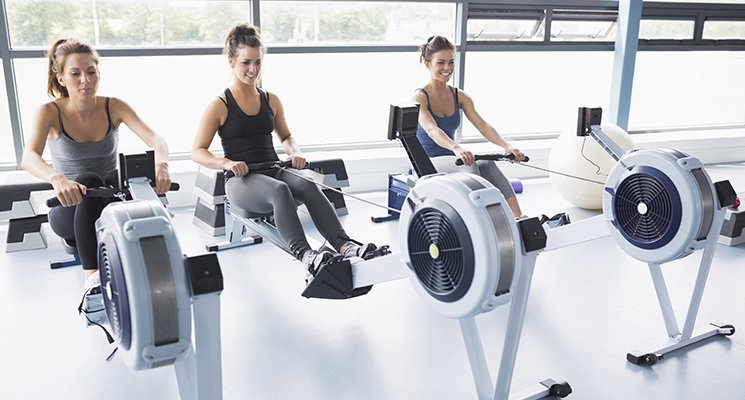
My point is, fitness centres have to keep up with changing fads, and this is true whether they’re on college campuses, independently owned, or part of a corporate wellness program. They have to do aerobics when people want aerobics, host Zumba classes when there’s excitement about Zumba, and so on. All well and good, but how exactly should a fitness center keep on top of changing trends when those trends involve deep-pocket investments in big, expensive pieces of equipment? Athletic Business magazine posted an interesting article on this topic a couple months ago, focusing on the growing popularity of rowing machines. One fitness industry veteran interviewed for the article put it this way: “Rowing will never be group cycling, but it is gaining its place with more hard-core fitness enthusiasts.” CrossFit aficionados have brought it nearly into the mainstream, and more and more gyms and fitness centres are increasing their stock of rowing machines, even lining them up and creating classes à la spinning classes.

But what if you’re a small outfit that can’t afford a whole roomful of new rowing machines? What if you don’t have the space for many large pieces of new equipment? How do you give your clientele the most up-to-date, exciting workout experience — the one they’ve been hearing so much about from friends and through advertisements, the one being touted at a rival fitness center down the street — if you don’t immediately have the resources for that kind of development?

As Athletic Business says, “To be sure, fitness facility owners needn’t run out and invest in a fleet of rowers, but nor should they continue to assume their current mix of cardio equipment is adequate to meet their members’ expectations.” That is, you have to focus on finding a balance. Then you have to make a plan for growth. Maybe you can start out by making space for one or two rowers. Keep close tabs on them: Make a note every time someone uses them. Note when they are empty for long stretches of time. Observe whether a line of people waiting to use them frequently forms.

Survey your clients to find out whether they’ve used them, when they did, for how long, and how they liked the experience. Ask whether they would sign up for a rowing class if one were offered. Set up a temporary class with a very limited enrollment (even just three or five would be okay). How is it received? What would participants change? Do they want more?

A business can’t change its programs and equipment the way teenagers change clothes — adoption of new fads should happen slowly, after testing, focus-group research, data-gathering, and trial-and-error. After you’re convinced that a fad is here to stay, and after you’ve conducted adequate research among your user base, then you can take the plunge and buy the equipment. Just make sure that when you do you’re keeping half an eye on the next emerging trend, because you’ll want to start researching that one too.

Oh, one last thing. After writing this I got curious and called my alma mater’s athletic center. I was told they recently ordered four new rowing machines!

nutrition complete 4.jpg

Add to the Client Experience with Nutrition Complete

« Blog | Written by ezfacility | | (0) Comments |

Over the last decade our industry has seen a boom in the latest gadgets and innovations revolving around fitness equipment within the club. However, the same old problem remains – your members are leaving. The fact is, approximately 80% of members who join a gym are coming to lose weight, but rarely do they ever succeed. Although members may lose 400 calories by running on a treadmill for 60 minutes, they do not always meet their goals. Why? One reason is that, when members leave the gym they often times consume twice as many calories as they have burned, mainly by eating the wrong foods. Achieving weight related goals is 20% exercise and 80% nutrition. “We are what we eat” and your members need a helping hand to achieve their goals. Otherwise they are going to become disillusioned and leave, again and again.

Nutrition Complete is the only proactive nutrition tool designed specifically for the health and fitness industry. While members enjoy the benefits of improved health, saved money, achieved goals and a more organised lifestyle, the clubs are benefiting from a value added upsell to existing membership fees, extra revenue and better retention:

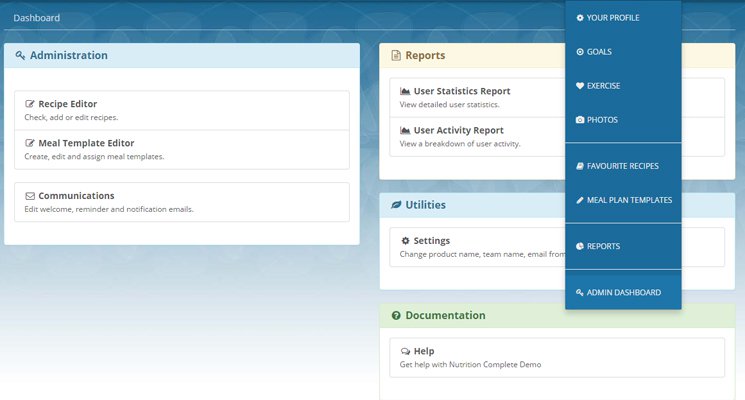
  • Personal Dietary Profiles will help your members to discover their nutritional needs by displaying recipes and meal plans that will suit their age, weight, height, gender, activity level and diet types for each day.
  • Personal goal setting will allow members to enter their goals and keep track of their progress.
  • Powerful recipe search–powered by Yummly.com–will allow users to filter and search through millions of healthy recipes by meal type and preparation time.
  • Add beverages to your meal plan and know how many calories are consumed with each drink.
  • Shopping list generation and delivery. Nutrition Complete integrates with mySupermarket.co.uk allowing members to purchase ingredients online from their favourite supermarket and delivered directly to their door. On top of saving time on shopping, it also helps members to compare prices across all major supermarkets, resulting in massive savings on their grocery bill.
  • Meal plan/ Recipe Printing. Members can save their meal plans, create shopping lists, and print both.
  • Controls portion sizes allowing members to lose weight effectively.
  • Dietary option templates to suit everyone`s dietary preferences including: vegan; vegetarian; pescatarian; red meat free; gluten free; dairy free; nut free; shellfish free; seafood free.
  • Meal statistics will show the percentage of RDA for each member that their current meal provides, for the selected day.
  • White Label. Want to create your own brand and use your own colour schemes? Nutrition Complete can be fully tailored to fit with your brand image.
  • Add your own recipes and meal templates for your members and decide which locations and members can view them.
  • Integration with Fitbit makes goals tracking just easy. No need to record your progress–everything is done automatically.
  • Members can subscribe to free motivational e-mails to keep them going.
  • Recipe rating will show you the most favorited recipes and allow you to rate them.

Learn more by visiting https://www.nutritioncompleteonline.com/.

Moto 360 in Cafe (1).jpg

Making Your Facility Wearable-Friendly

« Blog | Written by ezfacility | | (0) Comments |

After the recent release of the Apple Watch and continued release of Android Watches, wearable technology (wearables) seems to be all the buzz these days. With the involvement of these major players and their cult-like following, it’s clear that wearable technologies are not going away anytime soon. If you haven’t already, it may be time to start thinking about how to make your facility more wearable-friendly.
Wearables are electronic devices that are physically worn, either incorporated into a piece of clothing or as an accessory. Their capabilities make it easier to monitor certain aspects of your life, such as calories burned, distance ran, emails, and even messages. In essence, wearables aim to make life much more convenient.
The wearable-tech market is filled with a variety of products, with the two popular ones being fitness trackers and smartwatches. But what’s the difference between the two? A fitness tracker monitors physical activity without the need to manually input data, while smartwatches act as an extension of your smartphone. Despite their differences, fitness trackers are slowly being developed to display time, incoming calls, emails, and notifications—much like a smartwatch.
So why should this matter to your business? According to Business Insider, it is expected that in 2019 there will be more than 145 million wearables shipped worldwide, as compared to this year’s 30 million. With Google and Apple in the mix, it’s believed that many mobile users will gravitate toward the Apple Watch and devices that operate Android Wear. A common thread among those adopting smartwatches into their lives is that a majority will be using them for fitness purposes. Keeping that in mind, how can you incorporate wearables into your facility?
Opening your facility up to wearables can be done by making a convenient device even more convenient to use. For example, a recent Android Wear update allows users to escape the tethered range of Bluetooth and operate their smartwatches without their phones being near—as long as both devices are connected to Wi-Fi. Apple Watch is expected to incorporate this feature in the near future. Consequently, it’s a great idea to offer your clients free Wi-Fi so they may take advantage of such a feature. In addition to free Wi-Fi, send your members who have wearables with displays their ID card via email. Having their ID card (compatible with your club management software) in their inbox encourages them to use their device to check-in, and it’s also one less thing for them to carry. Technology is always changing, as are consumer preferences, which is what makes it so hard to predict the next big thing. One thing that is clear is all signs point towards the continued integration of wearables into daily life—which makes this the perfect time to make sure your facility is accommodating these devices and their owners.

devices

Train Employees Efficiently—Online

« Blog | Written by ezfacility | | (0) Comments |

If you run a sports facility, fitness center, or gym, you’ve probably embraced technology—these days, it’s impossible not to. You have your social media sites streamlined and constantly updated. You have your employees carrying around tablets for instant accessibility and communication. You have gym members uploading data from their personal fitness devices into your club management software. You might even have your fitness studios hooked up so members at home can stream classes. But have you thought about online training for your employees?
In this industry, training is crucial for some skills and types of knowledge. Think of pool management, for example. No matter what type of facility you run, if you’ve got a pool, your aquatics team needs to know, for starters, how to circulate and filtrate water, how to test for contamination and handle disinfection, and how to understand water chemistry concepts and calculations. Maybe you have the in-house resources—the time, the personnel—to pass this knowledge along.
If you don’t, signing your employees up for online training courses is the most efficient and effective way of getting them up to speed. Athletic Business runs a pool management course in partnership with the National Swimming Pool Foundation. Eight hours long, the interactive class promises to give your employees all the information they need to operate a pool expertly. The Aquatic Training Institute also offers a course, culminating in pool technician certification. Universities and MOOC (massive open online course) providers, such as Coursera, edX, and Udacity, are likely to offer free online pool management classes of their own.
In fact, universities and MOOC-providers are go-to web presences for all of your facility’s training and professional development needs. Personal trainers can find specific classes to address areas of knowledge they may be lacking, such as how to work with elderly or disabled populations, how to incorporate high-intensity training into existing workouts, and how to work with injured athletes. In this age of the Internet, almost any skill you or your employees need to develop can be learned cheaply and effectively online. You might have to invest some time into researching the options, but the investment will pay off in spades when you find yourself with a crew that knows what it’s doing (or knows how to find out what to do when it doesn’t know what it’s doing).
So how do you begin to incorporate online training? Whenever it makes sense, require new hires to educate themselves via courses you specify or allow them to choose from. This is an excellent way, in fact, to use inevitable downtime during the first couple weeks of employment, when new hires are learning the ropes. For existing employees, offer incentives. Give them a day off in exchange for completing a course, or throw a giant staff appreciation party—maybe even consider paying a small amount for each class an employee takes. It won’t be long before your staff realizes that, in addition to boosting your facility’s overall performance level, you’re offering them an opportunity for personal growth.

different workouts

Boost Retention: Help Your Members Achieve Their Goals

« Blog | Written by ezfacility | | (0) Comments |

There’s a powerful little word in our industry, one we love (when things are looking good) and hate (when things aren’t). I’m talking, of course, about “retention.” The word carries some kind of magical power. If retention is working in our favor, that’s an indication that business is good and we’re making the right decisions. If it’s not, it’s an indication that something — something — is off, but often it’s mysterious what that something is.
The thing that makes great retention an especially slippery goal is that it depends so much on factors in the lives of our individual members; factors that we couldn’t possibly control. Whether each member is happy or depressed, employed or suddenly unemployed, in a good relationship or in a psychologically draining one — each of these factors, and dozens of others, contributes to a member’s decision to stay or go.
Fine. Some stuff you have to let go of right? No sense in getting worked up over things you can’t do anything about. But what about the things you can do something about? That’s what you’ve got to focus on, and for gyms, fitness centres, health clubs, and the like, that really means one thing: helping members achieve their individual fitness and weight-loss goals.
The key here is the word “individual,” because the fact is that no two bodies are alike. There’s no one-size-fits-all fitness or weight-loss program. Diet books, workout videos, and advice blogs might want us to believe otherwise, but the fact is that what works beautifully for one health club member might not result in any improvements for another; the HIIT routine that allows one person to become mean and lean in four weeks might not show results for another person until after six or eight weeks. This, incidentally, is the beauty of the gym. The gym is staffed by real, live humans: trainers, concierges, nutritionists, class instructors, and cardio equipment experts who can listen to members express their goals, worries, and limitations, and help them chart out the best possible course for themselves. The best, most successful businesses in our industry do just this: They listen and respond accordingly.
So, back to that magical equation: improving retention by helping members achieve their individual fitness and weight-loss goals. If you want members who keep coming back, you have to offer them human attention. Employ knowledgeable, caring staff who are trained to:
1) Ask your members what their goals are; these can be tiny or huge, about health or about weight, short-term or long-term. The important thing is that they have goals, and that your staff knows how to help them define those goals.
2) Construct a realistic plan of attack to help them meet their goals. This means finding out what they enjoy in a workout and what they can’t bear — if they aren’t enjoying it, they’re not going to do it. It also means determining what kind of commitment is sustainable for each member. If they can’t keep up with the schedule, they’re likely to quit.
(3) Offer them support and guidance throughout. You just can’t do this kind of thing without a community, without someone cheering you on.
(4) Revise the plan if it’s not working. Help your members check their progress and make adjustments as needed. Can they handle more reps? Should they be doing less? Is there any measurable improvement? What are they struggling with?
It is also crucial to have a gym management software that allows you to track this critical data. With an all-in-one software that allows trainers and staff to create client profile pages, scheduling for both trainers and clients, as well as client fitness assessments, you will be making your lives and the client experience so much better!
Again, the purpose of all this — in addition to helping your members — is to keep them coming back. With the kind of attention outlined here, and the kind of help that will lead them to a better understanding of the individual plan that’s best for them, they won’t be able to help themselves.

Trade Show 2.jpg

Why Conventions are Good for You

« Blog | Written by ezfacility | | (0) Comments |

It’s almost that time again, folks—IHRSA convention and trade show time. The upcoming event, slated for the mid week of March in San Diego, will mark IHRSA’s 37th year of gathering industry members for discussion, exploration, learning, marketing, and all-around celebration of the health and fitness world. Here’s why, if you haven’t registered already, you should consider doing so; if you have registered, here’s why you’ll be happy you did.

1) Connection. First and foremost, attending a convention or trade show—any convention or trade show, but especially the industry’s largest—gives you the opportunity to connect with others in the field. Sure they may be competitors, but your competitors have something to teach you. Happily, participants who choose to attend events like conventions generally do so with an open attitude. Through casual conversations, over meals and beverages, meetings and introductions, ideas are transferred and transformed. Want to know how the gym down the street handles retention issues? Want to understand why that other baseball center is so successful at attracting new customers? Here’s your chance to find out.

2) Education. The latest industry news comes out during conventions like IHRSA’s. Statistics on the health of the industry, trends to keep an eye on, threats to look out for, and the most up-to-date word on major players all get talked about here first. Also, conventions can be an invaluable source of information about best practices. How do other clubs handle issues like employee training, member retention, locker-room cleanliness, and difficult clients? Every topic is fair game for discussion at such conventions, and you might find yourself going home with ideas you want to implement immediately.

3) Relationship-building. Okay, this is a lot like the first item in this list, but what I’m talking about here is bigger and deeper than a mere connection. Connecting with others in the industry is important and building relationships with them is crucial. I want to emphasize this. As with any endeavor, you’re more likely to succeed with your business if you’ve got a solid, reliable support system; this is true on all levels. The salespeople looking to sell you products at a trade show are not merely trying to fill their pockets. They really want the opportunity to meet you, get to know you, understand your needs and desires as a customer. Industry reporters, trade organizations, fellow business people—everyone is worth considering as the source of a potentially valuable relationship.

4) Sharing. Even if it’s easy to forget for most of the year, conventions and trade shows can serve to remind you that the difficult work you do is the same as the difficult work others do. And just as you can gain ideas and tips from other facility folk you meet at such events, other facility folk can gain ideas and tips from you. You might even seek to take part in a panel or give a talk. The pay-off might not be immediate, but eventually they’ll become clear, in tangible and intangible ways, you’ll reap the benefits of having been a part of a major event for months to come—at least until next year’s convention.